

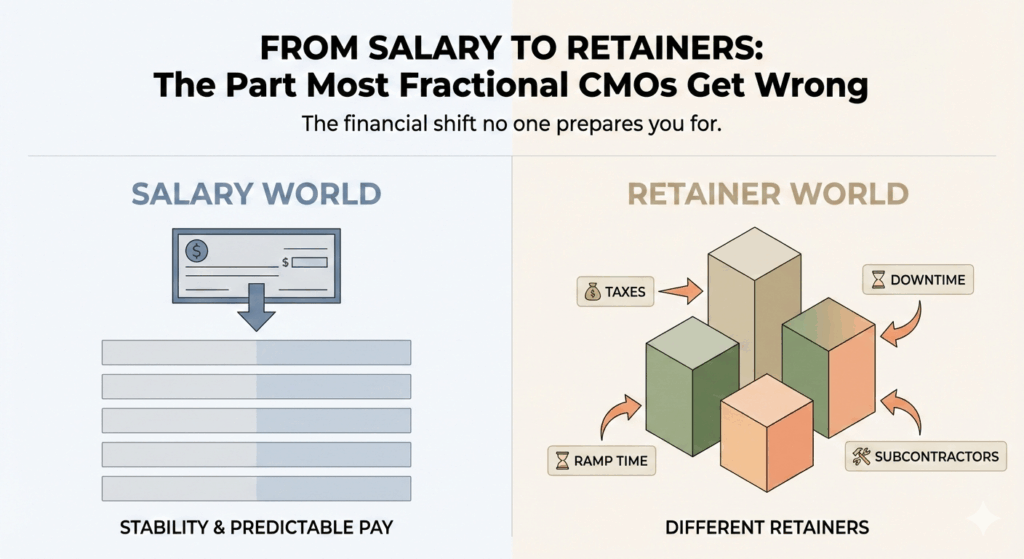
For fractional CMOs & GTM leaders who want “busy” to actually mean “profitable.”
When you step out of a full-time leadership role into fractional or independent work, everyone talks about lead flow, positioning, and retainers.
Almost no one talks about the quiet, unsexy shift:
You just went from employee math to owner math.
On salary, your financial life is buffered and pre-packaged.
On retainers, every decision about how you price, structure, and pace work shows up in your bank account within a few months.
This article is about making sure your retainers don’t just sound good on LinkedIn — they actually carry the financial weight of the business you’re now running.
1. What You Really Lose When You Leave Salary
When you walk away from a Director / VP / CMO role, you don’t just give up:
- A steady paycheck
- Health insurance
- A 401(k) match
You also give up a bunch of invisible infrastructure:
- Automatic tax withholding – nobody’s skimming off the top for you anymore.
- Paid downtime – vacations, holidays, slow weeks between big pushes.
- Internal ops – payroll, finance, HR, and systems that quietly keep things moving.
Your retainers now have to pay for all of that, plus your actual compensation.
Most fractional leaders only price to replace their net salary. That’s why they feel “booked out” but not truly ahead.
2. Retainers Have to Cover 4 Buckets (Not One)
Every retainer you sign isn’t just “$X per month.”
It’s your contribution toward four buckets:
- Your take-home pay (what hits your personal account)
- Taxes (federal, state, self-employment)
- Business overhead (tools, software, legal, accounting, support)
- Downtime & risk (gaps between clients, scope creep, churn)
Most people only price for #1. Maybe #2 if they’re cautious.
But if you don’t deliberately fund #3 and #4, you’ll feel like you’re sprinting just to stand still.
3. You Don’t Sell Hours — You Sell Calendar Space
On paper, you might think:
“I’ll just bill 80–100 hours a month. Easy.”
But as a fractional CMO / GTM leader, your calendar doesn’t behave like a freelancer’s.
A more honest breakdown:
- Client work & leadership: 60–80 hours/month
- Sales & marketing yourself: 20–30 hours/month
- Admin, ops, invoicing, follow-up: 10–15 hours/month
- Thinking time: strategic work that doesn’t look like “doing,” but is the whole value
You’re not selling “time in a chair.”
You’re selling ownership of a slice of your capacity.
That’s why pricing by “hours” alone undercuts you. Your retainer has to reflect:
- The mental load of owning their GTM
- The coordination cost (teams, agencies, leadership)
- The fact that you can’t load 40 hours/week of client work without destroying quality
Think of your capacity in slots, not hours.
4. A Simple Retainer Math Example
Let’s run real numbers.
Say your goals are:
- You want $12,000/month hitting your personal account.
- You’re in a tax situation where 30% of business profit goes to taxes.
- Business overhead (tools, software, legal, bookkeeping, coworking, etc.) runs about $2,000/month.
- You want a buffer for downtime and churn.
Here’s the math:
- Start with take-home goal:
$12,000 - Gross up for taxes (approx. 30%):
$12,000 ÷ (1 – 0.30) ≈ $17,150 needed in profit - Add business overhead (~$2,000):
$17,150 + $2,000 = $19,150 in monthly revenue - Add a risk / downtime buffer (say 15–20%):
~$19,150 × 1.2 ≈ $23,000/month as your real revenue target.
So if you want your life to feel like a stable “$12k/month salary,”
your business likely needs to bring in ~$22–25k/month.
That’s the gap almost every new fractional leader underestimates.
5. How Many Client Slots Do You Actually Have?
Now connect that to capacity.
Let’s say:
- You decide you can sustainably support 3–4 real clients at a time.
- You want at least one day/week where you’re not in client calls (for deep work & sales).
If your target is $23k/month, simple math:
- 3 clients → need to average ~$7,500+/month per client
- 4 clients → need to average ~$5,750+/month per client
That doesn’t mean every client has to land exactly there, but it sets a floor.
So instead of asking:
“Will they pay $3k/month for this retainer?”
You start asking:
“Is a $3k/month retainer worth burning one of my slots?”
For most experienced GTM leaders, the answer should be no — that’s a project, not a retainer.
6. The “Too Many Tiny Retainers” Trap
A pattern I see all the time:
- 5–7 clients at $1.5k–$3k/month
- Your calendar is jammed
- You’re “busy” and “in demand”… and quietly frustrated
The problems:
- Constant context switching kills your strategic value
- One churn or late-paying client hits disproportionately hard
- No space to take on a truly high-value engagement when it appears
The fix isn’t “work harder.”
It’s re-basing your minimums and intentionally consolidating into:
- Fewer clients
- Higher retainers
- Clearer scopes
You become more impactful, easier to work with, and far less fried.
7. Don’t Forget Ramp: Price the Onboarding Phase Differently
The first 60–90 days with a new client are rarely “steady-state.”
You’re often:
- Auditing GTM, funnels, and messaging
- Fixing or rebuilding analytics
- Untangling existing martech
- Re-aligning leadership around positioning
That’s heavy work. Yet most fractional CMOs charge the same flat fee from Day 1.
Two better models:
- Onboarding Retainer + Ongoing Retainer
- Months 1–2: Higher retainer (e.g., $10k/month) to cover discovery, rebuilds, strategic resets
- Month 3+: Ongoing retainer (e.g., $6–7k/month) once you’re in an execution/optimization rhythm
- Strategy Build Fee + Retainer
- One-time “GTM reset” project (clear scope, clear deliverables)
- Followed by a smaller retainer focused on leadership, calibration, and optimization
Either way, the principle is the same:
Ramp work should be paid like ramp work.
8. Turning Retainers Into Predictable Personal Income
Even when the business math is right, a lot of fractional leaders still feel “feast and famine” in their personal life.
That’s usually because they’re moving money from business → personal reactively.
A simple structure helps:
- Decide on a fixed “owner paycheck.”
- Example: You transfer yourself $6k on the 1st and $6k on the 15th.
- That’s your personal “salary,” even if business revenue swings.
- Leave the rest in the business.
- Builds a buffer for lean months
- Smooths out irregular payments and late invoices
- Makes larger investments (assistants, tech, coaching) less stressful
- Review quarterly instead of constantly.
- Once a quarter, look at business cash and decide if you want to increase your owner pay or take a bonus.
This is how you turn lumpy retainer revenue into calm, predictable personal income.
9. A 20-Minute Retainer Audit You Can Do This Week
Grab a notebook and answer these:
- What’s my true monthly take-home goal (not “it’d be nice,” but “this covers my life”)?
- What’s my estimated tax rate on profit?
- How much do I actually spend each month on business overhead?
- Realistically, how many client slots do I want to maintain?
- Based on that, what’s my minimum viable retainer per slot?
- Which current retainers fall below that line?
- What would need to change (scope, price, or structure) for those to make sense again?
You don’t have to fix everything overnight.
But getting the numbers in front of you puts you back in the operator’s seat.
10. If You Want Help With the Owner Math
If you’re a fractional CMO or GTM leader and you’re realizing:
- Your calendar is full
- Your work is strong
- But your financial systems still feel like a patchwork…
This is exactly the lane I live in.
I help consultants and fractional leaders build simple, audit-ready financial systems that match how their revenue actually works — retainers, projects, performance, the whole mix — so they can scale without the backend chaos.
If you’d like a second set of eyes on your retainer math and pay-yourself structure, send me a message with “Retainer” and I’ll walk you through what your numbers could look like.
— William Copeland
Copeland Bookkeeping | Greenville, SC